The Desert Tree Pantry
Mesquite, palo verde, and desert ironwood. Tree beans, flowers, flour, and the "nurse trees" that shelter young saguaros and the rest of the desert community.

Cultural production, strategy, and community storytelling from Phoenix and across Arizona.
Food, Memory, and the Sonoran Desert
A one-hour talk and tasting with Jeffrey Lazos Ferns
Available to Arizona libraries and community organizations through Arizona Humanities AZ Speaks.

Most people see the Sonoran Desert as something to drive through, admire from a trail, or escape in July. I see a pantry, a medicine cabinet, a hardware store, and a family album.
The saguaro outside your library has fed people and wildlife for generations. The mesquite in the parking lot drops pods that can be milled into a sweet, high-fiber flour. The creosote that gives the desert its smell after rain has been used as medicine longer than anyone can count.
Living Landscapes is an invitation to look again at the place where you live and to taste it.
“This program was on one of the best. Such an informative presentation and Jeffrey was so engaging and kind. I would recommend this program to every library!”
In one hour, I take audiences on a walk through the Sonoran Desert without leaving the room. We move through the landscape the way I do on my guided plant hikes, one relationship at a time.
Mesquite, palo verde, and desert ironwood. Tree beans, flowers, flour, and the "nurse trees" that shelter young saguaros and the rest of the desert community.
Saguaro, prickly pear, and cholla. Fruit harvests, syrups, nopales, and calcium-rich cholla buds roasted and stored through the seasons.
Creosote, brittlebush, and triangle-leaf bursage. The quiet, gray-green plants that carry the desert's medicine, incense, and healing traditions.
How agave was cultivated for food and cordage, and how some hillsides still hold the planting lines of gardens tended hundreds of years ago.
Why the Sonoran Desert, with its two rainy seasons, is one of the most diverse deserts on Earth, and how Indigenous knowledge reads the land, sky, and rain.
The javelina, Gila woodpeckers, long-nosed bats, white-winged doves, native bees, and roadrunners that pollinate, plant, and prune this desert. Every animal has a role, and so do we.
The Indigenous farms, seed keepers, and community organizations keeping desert seeds, languages, and food traditions alive across Arizona right now.
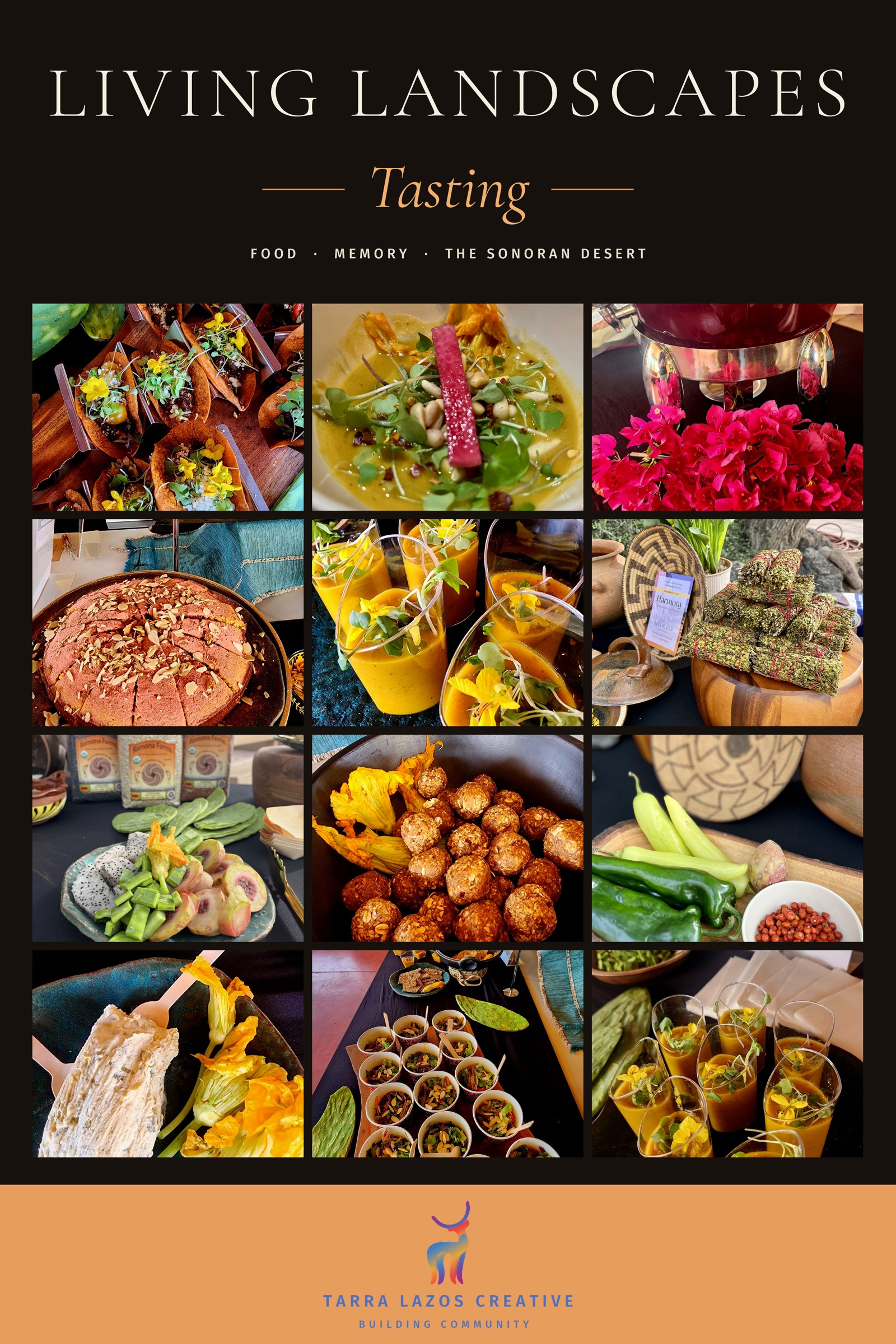
Every presentation includes a tasting of foods from the Sonoran Desert plantscape. Depending on the season, guests may sample items such as mesquite, prickly pear, desert teas, nopalitos, and other traditional staples.
Tasting changes the conversation. People who have walked past a prickly pear for twenty years taste the fruit and start asking questions. That curiosity is the whole point.
This is not a class in becoming a plant expert. I think of myself as a student of nature, and I want audiences to leave as students too: noticing, asking, and paying attention.
The Sonoran Desert is Indigenous homeland. Many Native nations have deep ancestral ties to this land and continue to care for it today. Living Landscapes connects desert ecology to history, migration, identity, and cultural resilience, and offers practical insight into sustainable living in a time of heat, drought, and change.
When people understand that the landscape is alive and connected, they start to care for it differently.

I call mesquite the tree of life because no other Sonoran Desert plant gives so much. From root to pod, every part of this tree has fed, healed, sheltered, or equipped the people who live alongside it.
Food. The ripe pods are the heart of it. Their sweet pulp is ground into a naturally sweet, high-fiber, gluten-free flour for breads, cakes, porridges, and drinks. The flowers can be eaten in spring, and the sap hardens into an edible gum that was once enjoyed as candy.
Medicine. The gum, leaves, bark, and roots have all been used in traditional medicine. Gum dissolved in water has served as a gargle for sore throats and a remedy for stomach trouble. Leaf teas and washes have been used for headaches and sore eyes, and the bark is valued for its astringent qualities.
Shelter, fiber, and fuel. The dense wood has framed homes and ramadas, made tools, and fueled cooking fires. Inner bark and roots have been twisted into cordage and woven into baskets and fabric, while the dark sap has served as glue, paint, and black dye.
A clarification. Not every part of mesquite is food. The pods, seeds, flowers, and gum are edible. The leaves, bark, and roots belong to medicine and material culture, not the dinner plate. Together, every part of the tree has a use.
Beyond Arizona. Mesquite and its close relatives grow in dry lands throughout the Americas, and Indigenous peoples have relied on them wherever they grow. In the Chihuahuan and Mojave Deserts, across Mexico, and into South America, where the tree is called algarrobo, families have gathered, stored, and milled the pods for generations. In Argentina's Gran Chaco, algarrobo flour is still made into bread and fermented drinks. In Peru and Chile, the pods have fed people since before the Inca.
A note from science. In 2022, botanists reclassified the American mesquites. Velvet mesquite, long known as Prosopis velutina, is now Neltuma velutina, and the name Prosopis is reserved for a few Old World species. You will see both names in field guides.
Harvest with care. Pick ripe, brittle pods straight from the tree, ideally before the summer monsoon. Pods collected from the ground can carry molds that produce aflatoxin, so leave them for the desert's wildlife and soil.
I'm Jeffrey Lazos Ferns, an Indigenous foodways educator, chef, artist, cultural worker, and master gardener with deep ancestral roots in the Sonoran Desert. I've spent a lifetime studying Indigenous plants and traditional foodways. My company, Tarra Lazos Creative, carries my grandfather's name and the lineage that shapes my work.
I founded the Arizonan Indigenous Culinary Experience and the Arizonan Indigenous Food Symposium as first-voice platforms for Indigenous chefs, farmers, and seed keepers. I lead Sonoran Desert plant hikes for visitors, journalists, and community groups, and I present Living Landscapes as an Arizona Humanities AZ Speaks speaker.
More about Jeffrey →Living Landscapes is part of the Arizona Humanities AZ Speaks program, which makes free, in-person, 60-minute public talks available to libraries, schools, museums, and nonprofits across Arizona. Arizona Humanities gives priority to rural host sites, so small and rural libraries are especially encouraged to apply.
The current AZ Speaks cycle runs through April 30, 2027.
Planning a private event, conference, garden club meeting, corporate gathering, or a longer program? Living Landscapes is also available as an independent booking, with options for an extended presentation, an edible and medicinal plant display, a fuller tasting, or a guided Sonoran Desert plant hike. Reach out and I'll shape a program that fits your audience.
Request booking informationWednesday, November 18, 2026 · 5:00 p.m.
Free, donations appreciated
360 Brewer Rd., Sedona, AZ 86336
Keep Sedona Beautiful Speaker Series, with support from Arizona Humanities.
Event details on Keep Sedona Beautiful ↗Saturday, February 27, 2027 · 2:00–3:00 p.m. · Free
495 E Western Ave, Avondale, AZ 85323